Black History Month always slows me down in the best way.
It asks me to look backward with gratitude and forward with intention—to think about the artists who made room where there was none, and what it means to work freely inside a craft shaped by their persistence.
As a Black woman, a mother, and a photographer working along the border, I don’t experience photography as something separate from life. It is braided into how I raise my children, how I build my business, how I hold space for families, and how I choose what moments deserve to be preserved.
Every session carries history, whether the client names it or not.
The Business I Chose to Build
Running a photography studio isn’t just about mastering light or creating beautiful images; it’s about stewardship. It’s about earning trust. It’s about understanding that when someone steps in front of my camera, they are handing me something fragile: a season of their life.
Black History Month reminds me that Black entrepreneurs have always had to build with both vision and resilience. The freedom to run a creative business today—to set my aesthetic, define my pricing, curate my client experience, and photograph Black families with softness and luxury—exists because others fought to be seen as artists long before it was safe or profitable.
I carry that knowledge into how I show up for my clients: calm, prepared, patient, and deeply intentional.
A City That Changed My Eye
Living and creating along the border has sharpened my sense of story.
This is a place shaped by movement; military families rotating in and out, multi-generational households putting down roots, cultures overlapping in kitchens and classrooms, children growing up bilingual in more ways than one. It is impossible to photograph here without noticing how much transition lives inside everyday moments.
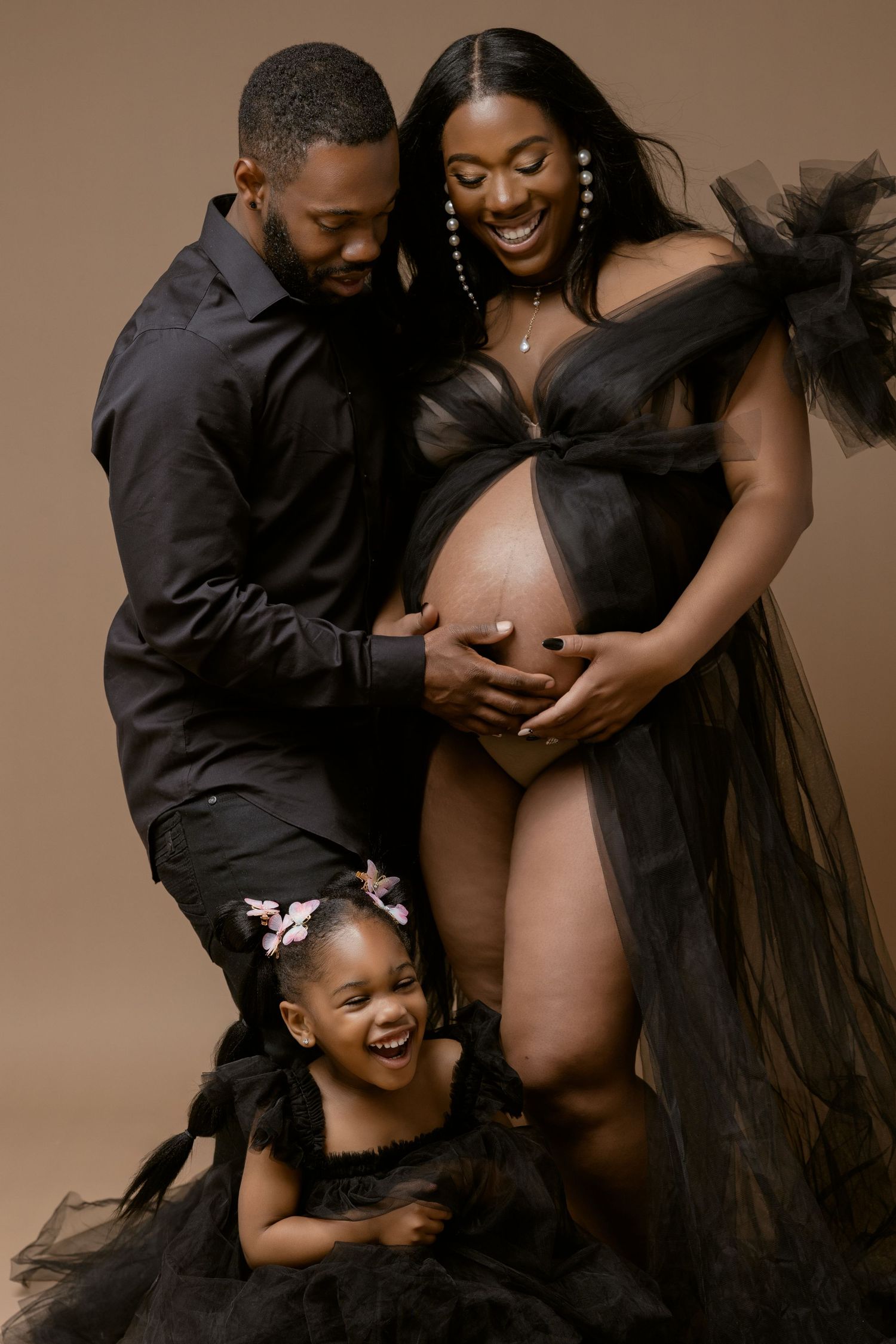
I think that’s why I’m typically drawn to portraits that feel grounded rather than flashy. Hands wrapped around waists. A child tucked into a parent’s shoulder. The way a family leans together without realizing they’re doing it.
Those are the details that last.
What Was Missing; and What I Made
When I first moved to El Paso, my relationship to photography shifted.
I wasn’t just looking at the city through the lens of a working creative, I was looking at it as a Black woman trying to document her own family. I needed portraits. I wanted images that felt elevated, tender, and accurate. I wanted to see myself reflected in the work I was browsing.
And I didn’t.
There were and still are very few Black photographers in this region. In all the years I’ve lived here, representation behind the camera has been scarce. That absence stayed with me. It made me pay closer attention to what was missing in local portfolios, and to what I wished had existed when I was searching for someone to photograph my own life.
That gap became part of what pushed me forward.
Starting my business here wasn’t just about building a studio—it was about offering something I had once needed myself.
Where Craft Becomes Reverence
Being a Black photographer means I don’t approach any session casually.
I photograph families, yes—but also individuals, maternity, branding, business owners, and fashion-forward portraits. Different bodies. Different skin tones. Different textures, seasons, identities, and stories.
That range requires intention.
It means slowing down with lighting instead of relying on shortcuts.
It means paying attention to undertones and highlights.
It means making sure darker skin is rendered rich and dimensional—not flattened, not over-brightened, not swallowed by shadow.
It means posing with care, speaking with gentleness, creating space for people to feel held rather than hurried.
Accuracy is respect.
And beauty lives in precision.
I don’t take lightly the responsibility of shaping how someone sees themselves in a photograph—especially when that image might become the one that hangs in their home, gets passed down to children, or represents their business to the world.
That awareness sits underneath everything I build.
What Motherhood Taught My Eye
Becoming a mother rewired how I photograph.
Time moves differently when you have children. You become acutely aware of how fast seasons pass—how quickly babies stretch into toddlers, how laughter sounds different at seven than it did at two, how one ordinary afternoon becomes something you wish you could step back into years later.
That awareness lives in my work.
I photograph slowly. I watch first. I wait for the in-between moments: the breath before a laugh, the way a child grips a sleeve, the softness that settles when a family forgets the camera is there.
Those moments feel small in real time.
They become priceless later.
Authorship Matters
As a Black woman behind the lens; I’m conscious of the weight, and the privilege of authorship.
For much of history, Black people were photographed without control over how they were framed or remembered. Today, being able to create images that center dignity, tenderness, luxury, and complexity feels deeply meaningful.
It shapes how I photograph Black skin in natural light.
How I style sets with restraint rather than spectacle.
How I speak to mothers about their bodies in transition.
How I build experiences for business owners stepping in front of the camera for the first time.
Representation isn’t a slogan to me.
It’s practice.
It’s who gets to be gentle.
It’s who gets to be monumental.
It’s who gets to be seen exactly as they are.
What I Carry With Me
Black History Month isn’t only about honoring the past—it’s about choosing what we build next.
For me, that looks like continuing to photograph families with patience and reverence. Continuing to run a business rooted in excellence and care. Continuing to create images that my clients will someday pass down—not because they were trendy, but because they felt true.
It looks like teaching my children that creativity is inheritance.
That artistry is work.
That legacy is something you shape with your hands.
And that every time you press a shutter, you are deciding what survives.